


Tiffany Yu’s book, THE ANTI-ABLEIST MANIFESTO, will be available in the UK on March 6, 2025, here.
At the age of nine, I was involved in a car accident where my dad was driving. He, unfortunately, passed away, and I sustained several injuries, including broken bones in one of my legs, which left me temporarily using a wheelchair for about four months. I also suffered a brachial plexus injury, permanently paralysing one of my arms, and much later, I was diagnosed with a mental health disability, post-traumatic stress disorder (PTSD).
I share that experience as the catalyst behind my work as a disability advocate. Navigating a world that wasn't built for people who can only use one arm has led me to think more creatively, be innovative, adapt and be resilient.
Being disabled can be a socially isolating and excluding experience, and many people forget that disabled people also need social connection, community and healthy relationships to thrive, just like everyone else.
I have leveraged these experiences to fulfil my mission to use my power and privilege to fight for more disability equity and justice. In many ways, I want to increase access and opportunity for the disability community, and I have done that in a few ways.
The first is through my social enterprise, Diversability, a community business of over 80,000 in our ecosystem that aims to build disability power and advance Disability Leadership. Being disabled can be a socially isolating and excluding experience, and many people forget that disabled people also need social connection, community and healthy relationships to thrive, just like everyone else.
The second way is by leveraging my background in finance. I began my career in investment banking at Goldman Sachs, and I now focus on what I call "disability-centered economic justice." At Diversability, we work to reinvest money back into the disability community. We do this by serving as a talent incubator, building an entirely disabled-run and disabled-led team. We also provide references and write letters of recommendation for our team members as they pursue new opportunities. Additionally, we strive to find visibility and paid opportunities for our community members.
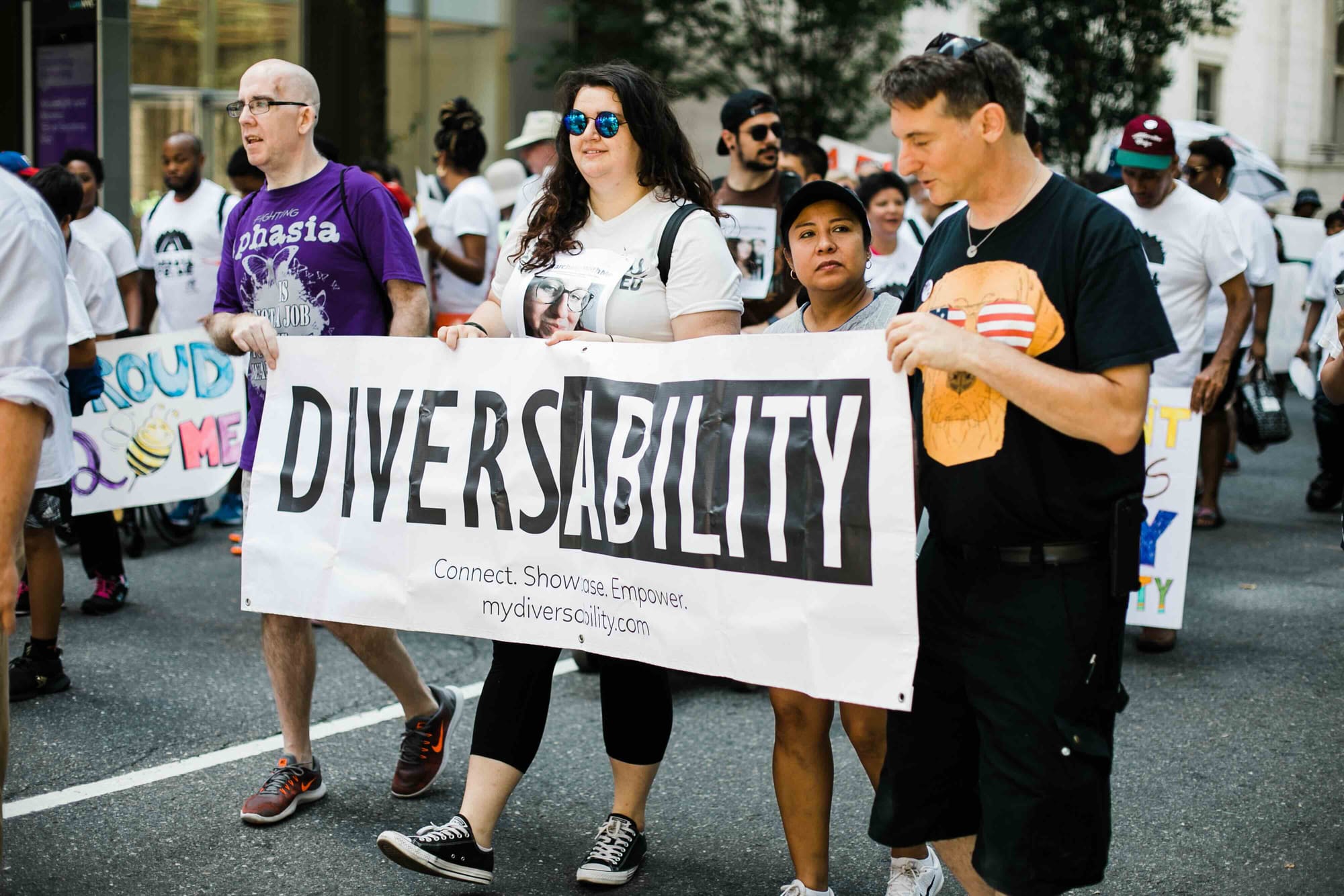
In addition to that, I co-founded the Awesome Foundation Disability Chapter, which awards $1,000 monthly microgrants to disability projects around the globe. To date, we've awarded over 85,000 US dollars to projects in 13 different countries.
I also started the Disability Empowerment Endowment Fund at Georgetown University. This endowment fund is focused on investing in disability initiatives, ranging from scholarships for disabled students to supporting disability student clubs, disabled artists or entrepreneurs in residence, research by disabled scholars, and the newly formed Disability Cultural Center. The way an endowment fund works is that after the initial amount is raised, which in this case was $100,000, a small percentage of it gets distributed every year, and then the rest gets invested in the market.
The third way I increase access and opportunity for the disability community is through civic engagement. From 2019 until 2022, I served on the San Francisco Mayor's Disability Council appointed by the San Francisco Mayor London Breed. One of my big wins was around the 30th anniversary of the Americans with Disabilities Act in 2020; I led the mayoral proclamation of July as Disability Pride Month in San Francisco. ADA 30 website was also created that included a listing of different events that were happening throughout July. I curated a digital art exhibition of Bay Area disability advocates and disabled leaders. Additionally, I also was able to get City Hall lit on July 26th in commemoration of the anniversary of the ADA.
Currently, I serve on the LA28 Olympic and Paralympic Games Working Group on Workforce Development and Local Hire. This voluntary advisory group brings together a handful of different local organisations to ensure that in the lead-up to the LA28 Games, we're focused on providing opportunities to different minoritized groups and ensuring that the workforce behind LA28 looks like Los Angeles.
For about 12 years after I became disabled, I didn't share the details of the car accident publicly, perhaps due to my familial shame or internalised ableism. I tried to hide my arm as much as possible, I told everyone that my dad was away on a trip, and I didn't tell anyone about the car accident for a long time.
Lastly, I have also taken my advocacy to social media, and I started a series on TikTok and Instagram called The Anti-Ableism Series, which features bite-sized ways that people can be better allies to disabled people. That series now has over 280 parts and over 5 million views. As a result of that, loosely inspired by the series, I now have a book coming out called The Anti-Ableist Manifesto. It is coming out in the US in October 2024 and in the UK in March 2025. This book follows a framework called Me, We, Us, which emphasises that the work starts with us, expands to our relationships and local communities, and ultimately extends to society to create systemic change.
It has not been an easy journey. As the daughter of Asian immigrants, I had internalised that I should not share anything that might be seen as shameful because it would make my entire family look bad. As a result, the loss in my family, specifically my father's passing, was seen as bad luck within my ancestral lineage that caused the death in our immediate family. The traumatic car accident was also perceived as part of that bad luck, as was my resulting physical disability.
For about 12 years after I became disabled, I didn't share the details of the car accident publicly, perhaps due to my familial shame or internalised ableism. I tried to hide my arm as much as possible. I told everyone that my dad was away on a trip, and I didn't tell anyone about the car accident for a long time.
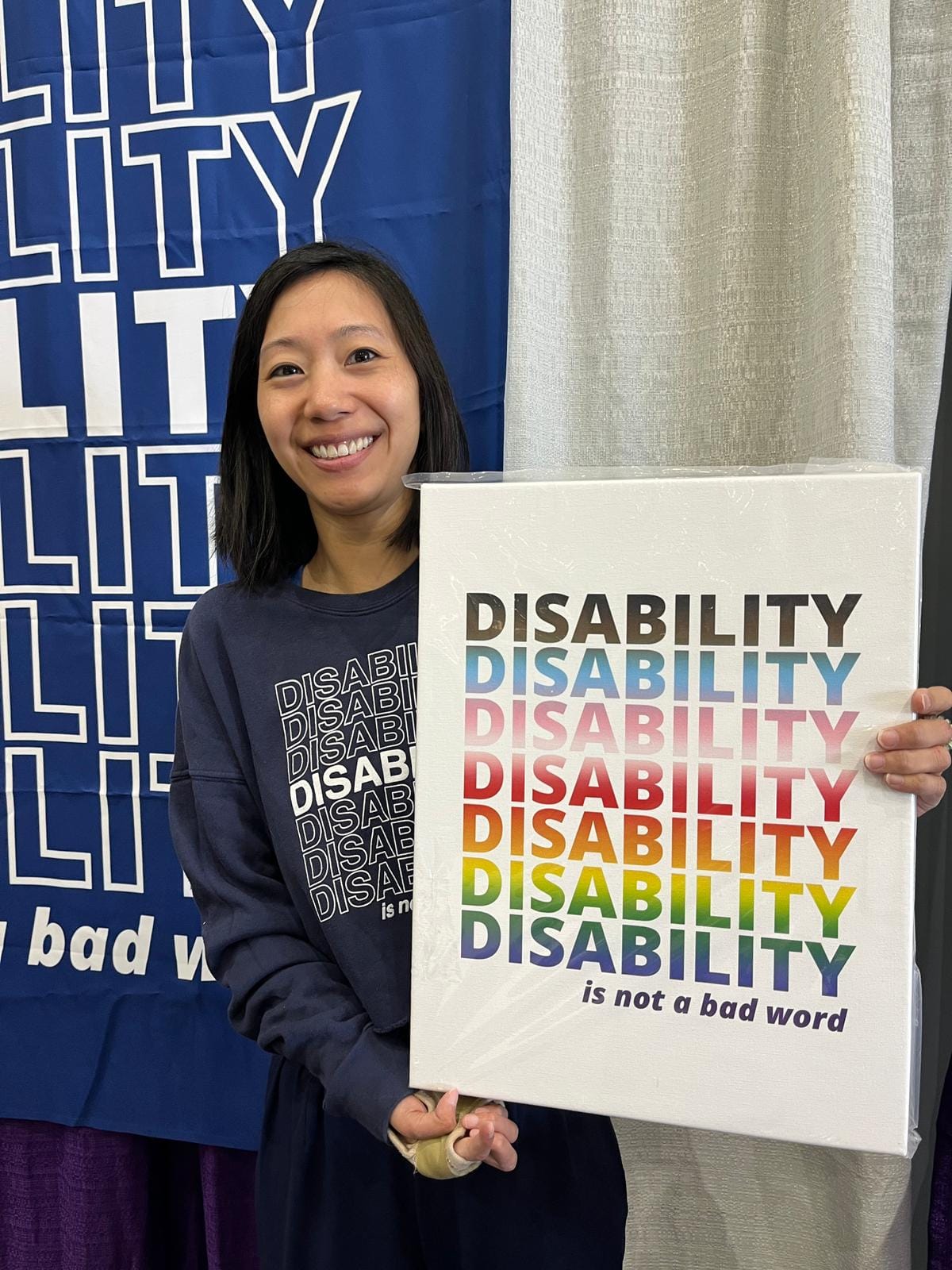
I am inspired by a quote from Francis Weller, who says, “The work of the mature person is to carry grief in one hand and gratitude in the other and to be stretched large by them. How much sorrow can I hold? That’s how much gratitude I can give.” The amount of grief I carry is how much gratitude I can give. For 12 years, I sat in a space of grief, suffering in silence in many ways. And over this 27-year journey of being disabled, I spent the first 12 years sitting in that grief and the last 15 years effectively unlearning that grief was the only place I could be.
My internalised ableism still shows up in some ways, but I feel extremely proud to be on this journey of connecting more deeply with the disability community, learning and unlearning, celebrating disability history, and uplifting and elevating disability culture.
I also reflect on the early days of trying to create Diversability. As we celebrate our 15th anniversary this year, I remember how difficult it was initially to get anyone to join. The first iteration of Diversability began during my senior year at Georgetown University, where we were Georgetown's first-ever disability student club. Slowly but surely, we began to grow our membership. More people started attending our events, largely thanks to the solidarity and allyship from my role as a leader in the Taiwanese American Community, which we had built during my first couple of years at university. They were the ones who supported me in those early years.
I could never have imagined that Diversability would achieve the level of visibility it has today, nor that my advocacy work would scale in this way.
I am extremely grateful, and I often reflect on past versions of myself to recognize and appreciate the journey I've been on. I am in awe of and deeply grateful for the progress I've made. I am also grateful not only for the community I've created at Diversability but also for being able to integrate into other communities that have made this journey much less lonely.
I am part of several supportive communities, including those of women entrepreneurs, Asian American and Pacific Islander (AAPI) creators and speakers, and individuals building membership communities. Being able to find these communities has been incredibly supportive, especially when I have felt alone in my experiences.
I have a TEDx talk called “The Hard Truths of Being a Pioneer,” where I discuss how lonely it can be to be the only one who fervently believes in your idea. However, I believe that if you truly believe in the solution you are creating for a problem you experience so intimately, it may take some time, but you will eventually find others who share your vision.
Disabled people need community and more economic opportunities to not only survive but thrive. There is a lot of work to be done to address bias, prejudice, and discrimination against the disability community.
I've grown to love my disabled body. This body has made me a triathlete - I have the medal to prove it. I also summited Mount Kilimanjaro, the tallest freestanding mountain in the world.
When it comes to milestones, I would say that what I am most proud of is that I love myself. It has taken me a long time to get to this place because I spent so much time in this disabled body with low self-confidence, low self-esteem, and even some self-loathing. Over the past couple of decades on this journey, I've grown to love my disabled body. This body has made me a triathlete - I have the medal to prove it. I also summited Mount Kilimanjaro, the tallest freestanding mountain in the world. In 2016, I began relearning how to bike, rock climb, archery, axe throwing, along with many other fun activities that I had counted myself out of for a long time.
Of course, there are many professional milestones I'm proud of as well. In 2018, I had the privilege of speaking on the first-ever series on disability inclusion at the World Economic Forum Annual Meeting in Davos, Switzerland. There I was, under 30 years old, rubbing elbows with world leaders, including the U.S. President, as well as leaders from academia, corporate, and civil society sectors, advocating for the importance of disability inclusion.
Additionally, I delivered a TED Talk titled “How to Help Employees with Disabilities Thrive,” which has garnered over a million views to date. During milestone months such as July (Disability Pride Month), October (National Disability Employment Awareness Month), and December (International Day of People with Disabilities), I often see key takeaways from that talk circulating on social media.
Most recently, Diversability won the grand prize in the Barclays Small Biz Big Wins contest. We were awarded $60,000 through a public vote out of 4,500 small businesses, which felt like an immense validation of our work and a financial boost that we don’t often see disability-owned companies get.
Finally, with my debut book, The Anti-Ableist Manifesto, coming out soon, I still find it hard to believe that I wrote an entire book. I wrote the first draft using speech-to-text —the same tool I'm using to draft my responses for this interview. This goes to show that if we prioritise accessibility and create an accessibility-first culture, many of us can achieve our dreams and goals, succeeding in ways we might never have imagined.
When I reflect on my trajectory as a disability advocate over the past 15 years, I often describe myself as an accidental disability advocate, community builder, and entrepreneur. In some ways, I guess I’m an accidental Disruptor, but I think what makes me a Disruptor is the fact that when I see a problem, I'm driven to take action. When I see an opportunity, I want to do something.
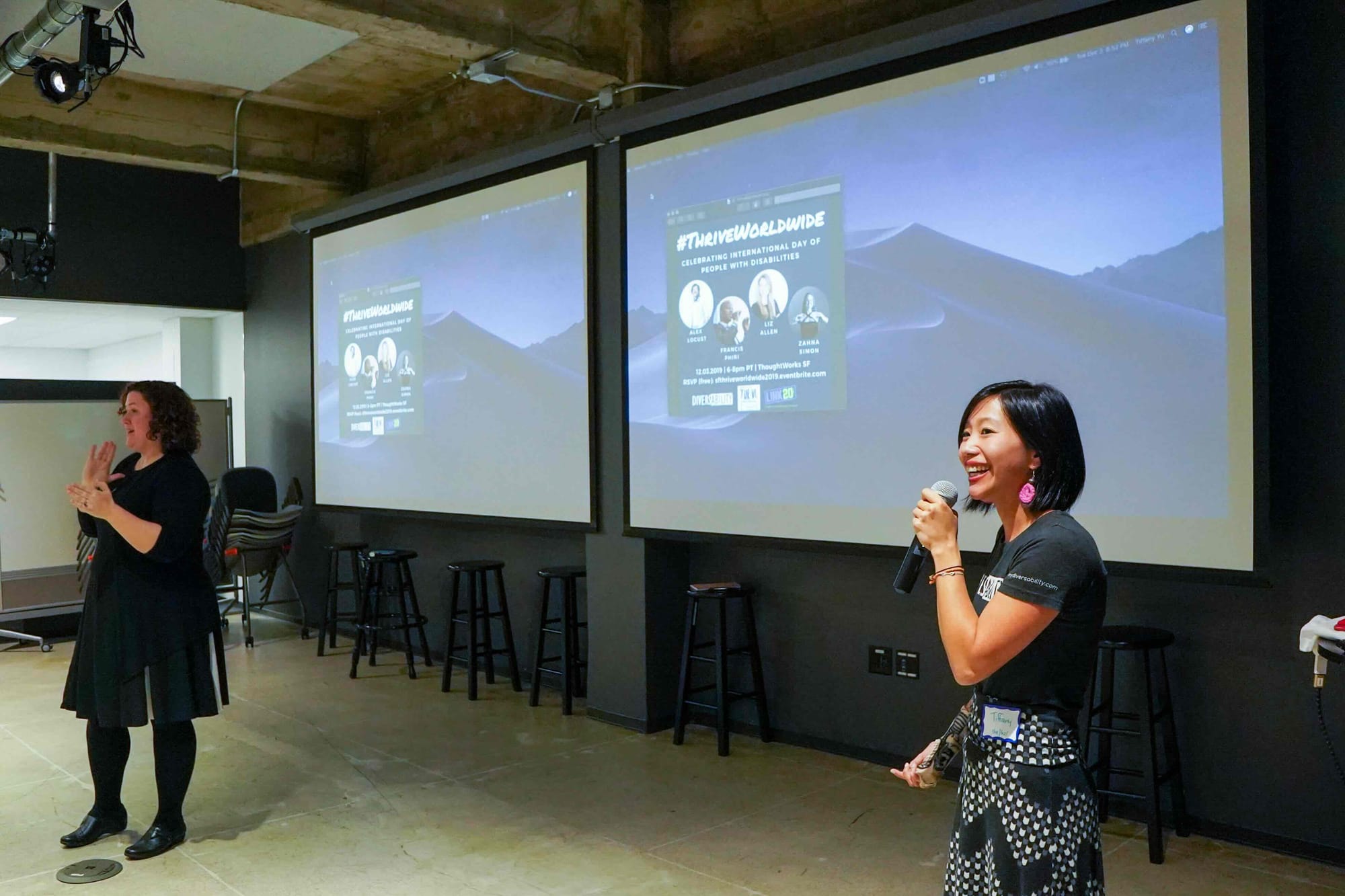
Looking back 15 years, I was very active in creating a Taiwanese American student club during my freshman, sophomore, and junior years at university. This experience in starting student clubs eventually led me to create Diversability, another student club focused on a different aspect of my identity.
Reflecting on all that Diversability has accomplished, I see how we turned challenges into opportunities. When traditional media wouldn't cover us, we created our own hype machine and press. When there were no platforms for disabled speakers, we curated our own events with disabled speakers. When I couldn't find a list celebrating disability leadership on a global level, we created one called the D-30 Disability Impact List.
When I wanted to give back to my university in a sustainable way that would support disability initiatives in perpetuity, I created and seeded the Disability Empowerment Endowment Fund. Given that less than 2% of philanthropic funding goes to disability advocacy globally, we decided to create our own micro-grant through the awesome foundation, Disability Chapter.
When I couldn't find a book that focused on actionable and transformative ways for people to show up better for the disability community, I wrote one. I am excited about the various ways I have become an accidental Disruptor. I hope my story inspires those reading to examine their own areas of influence and determine how they can make an impact. Even small changes in those spaces can change lives.
Tiffany Yu is the CEO & Founder of Diversability, an award-winning social enterprise to elevate disability pride, the Founder of the Awesome Foundation Disability Chapter, and the author of The Anti-Ableist Manifesto: Smashing Stereotypes, Forging Change, and Building a Disability-Inclusive World. Her TED Talk, How to Help Employees with Disabilities Thrive, has over one million views.
She serves on the LA28 Olympic and Paralympic Games Working Group and was a Co-Chair of the World Economic Forum Sustainable Development Impact Summit. At the age of 9, Tiffany became disabled as a result of a car accident that also took the life of her father.


Member discussion