


As a Black Muslim woman from an immigrant working-class background, I have always had an awareness of how my intersectionality affected what opportunities I had access to and how far I could go professionally. I was born and grew up in France, and the lack of creative career opportunities for people of my socio-economic background, combined with blatant discrimination and racism towards immigrants and their children, led me to move to the UK in search of better opportunities for myself.
I went on to study Clothing Design at Manchester Metropolitan University and was empowered to achieve more than what I aspired to growing up. Following graduation, I worked in the fashion industry for a few years and felt like I became part of a society that finally accepted me as I was. However, when Brexit happened, I felt unwelcome again as an immigrant and my sense of belonging was deeply affected.
Unpaid or low-paid work is still too common within the creative industries, creating an additional financial barrier for those who can’t afford to work for free or for low pay.
In 2020, when the George Floyd murder happened, I was shocked at how many people were surprised about how violent police brutality was when this had been the reality of so many Black people for so long. It made me realise that when it came to racism and social justice in general, we were not all on the same page regarding how much work still needed to be done and how important it was to speak up about injustice so we don’t ignore or normalise it.
For a really long time, I longed for someone to represent me, my experiences and what I cared about until I concluded that I was the only one who could represent and speak about all of those things truthfully. I also knew this would resonate with a lot of people. That’s what led me to do work that focuses on social justice and representation.
As someone who has felt unrepresented for most of her life and who has often felt powerless in the face of injustice, it’s important for me to use my work as a platform to amplify the voices of underrepresented people and empower people to do more towards a better society for all. I do this using all the mediums at my disposal.
I use Instagram to share art about issues and topics that matter to me in a way that is easy to engage with so it can reach other people affected by those topics but also people who might not have heard about what I am sharing at all. It’s a way to acknowledge and shed light on the experiences of people who might not be represented otherwise and to introduce issues and topics that could be considered niche or alien in some circles.
Public art, such as murals and billboards, allows me to reach an even wider range of people, especially people who would usually not be interested in engaging with the topics and issues I address. I also host workshops to make art and creativity accessible to people who might not traditionally have access to art, using a relaxed and welcoming setting for all to facilitate this. My goal is to nurture dialogue, empathy and understanding between people from different walks of life so they can take that away with them and contribute to building a society where all people are treated equally.
There needs to be more outreach to make creative career paths more visible and accessible to marginalised communities. Some young people have no awareness of what creative jobs are available to them, so they don’t even know how to access them.
I consider myself a Disruptor because I defy expectations of what a working-class immigrant Black Muslim woman should be and should be doing.
As a teenager, I had no idea what a graphic designer was because I never saw and met one, let alone one that looked like me. As a result, it made that career path difficult to access for me. It was only much later in life that I realised I could pursue graphic design if I wanted to. I was not an elite club reserved exclusively for middle-class white people, as I had previously thought.
Additionally, there needs to be more financial support available for people coming from low-income backgrounds to pursue creative careers. Unpaid or low-paid work is still too common within the creative industries, creating an additional financial barrier for those who can’t afford to work for free or for low pay. It also makes those careers appear not viable as professions.
Finally, more effort needs to be put into decentralising the creative industries from capital cities so people can fulfil their potential from wherever they are or where they come from. I had to not only leave my hometown but also my home country altogether to have a shot at the creative career I was after.
The internet and social media have helped greatly to reduce the need to move to a capital city to make it, but for some jobs, living in a capital city will be the make-or-break factor of a successful creative career. Everyone should get a fair shot at working in the creative industries, regardless of what their socio-economic background is or where they live.
Some milestones I am most proud of include:
- My ‘Decolonise Everything’ billboard for the Black Outdoor Art project in 2020 which was the 1st time I had my art on a billboard.
- My ‘Where Are You From?’ window installation for the Migration Museum in 2022 which was the 1st time I produced an installation for a museum.
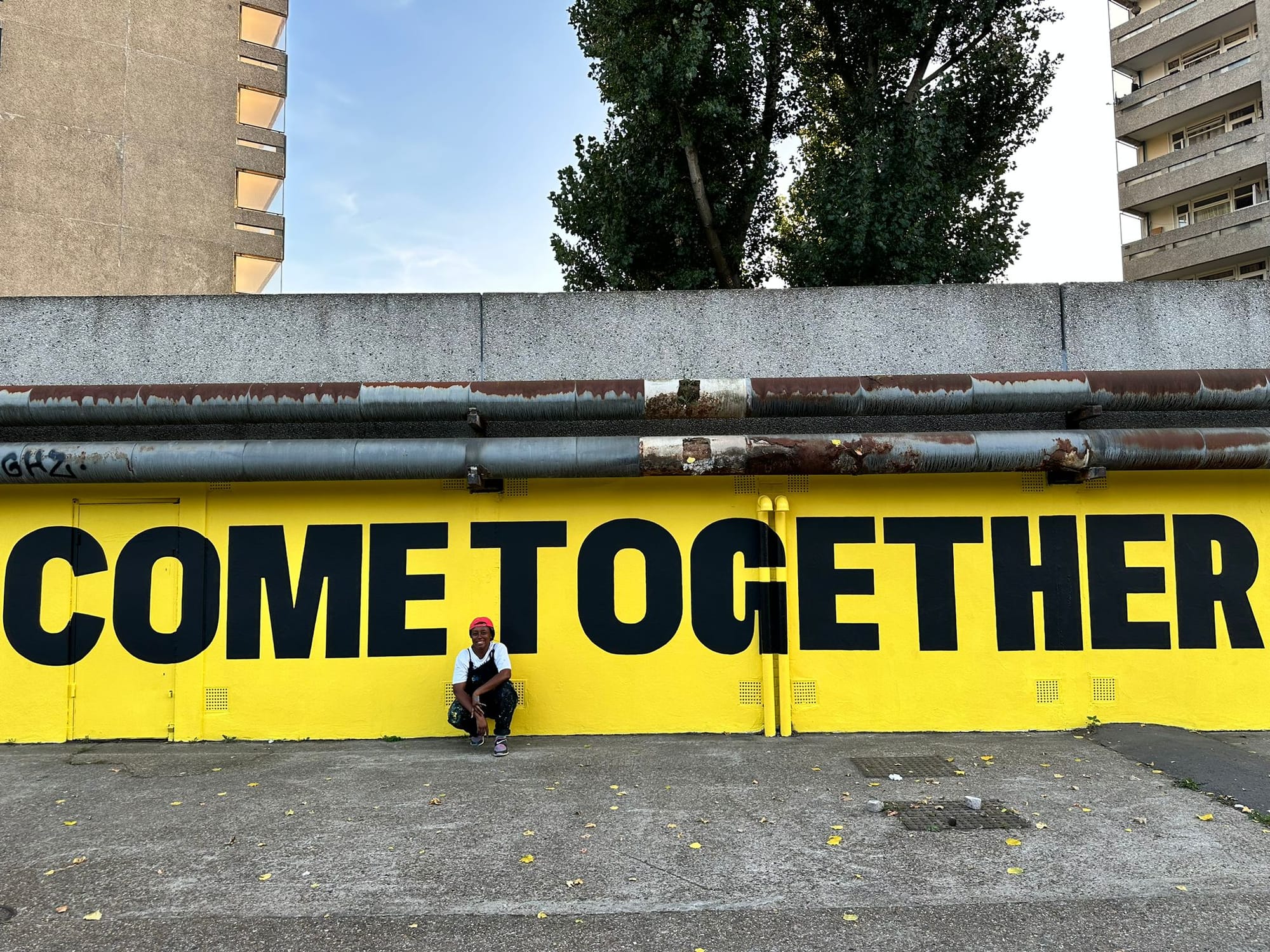
- My 70m long ‘Come Together’ mural in Thamesmead which is the biggest project I’ve ever delivered and also the 1st time I got to put together and manage my own team.
- The design update I did of the Atlantic Worlds gallery (a gallery which deals with the Transatlantic Slave trade) at the National Maritime Museum, where I created a visual identity that was more representative of the Black African experience.
- My ‘Art Is For All Of Us’ poster commission for the Tate shops, which was inspired by my lack of access to art growing up and which I hope will inspire more people to engage with art.
I consider myself a Disruptor because I defy expectations of what a working-class immigrant Black Muslim woman should be and should be doing. Through my art, I not only express myself as someone at the intersection of several marginalised groups, but I also challenge injustice and harmful social norms in ways that can empower others to do the same.
Nadina Ali is a socially engaged, self-taught graphic artist from Marseille, now based in London. She’s passionate about social justice and representation. She uses bold and colourful typography to create art that addresses those topics in ways that challenge the status quo and are easier to engage with for a wider range of people.


Member discussion