


My mum told me I sang before I could talk. That makes perfect sense to me because that’s how I still process the world around me. I was born in Ibadan, Nigeria and grew up in Benin City, where my family is from. We moved to London when I was 7 years old. When I was little, we had a tradition called Family Sundays, which was a talent show in our sitting room.
Every Sunday after church, we would each perform a song or dance in front of the family (my parents, three sisters, my brother and I). It was pretty hardcore but fun. Sometimes, you would receive a rapturous standing ovation, and sometimes, you’d be laughed off the make-shift stage. I loved to perform Fela Kuti, Kate Bush and Yvonne Chaka Chaka. Oh my goodness, I really thought I was That Girl. It was such a magical time.
I am a working mother and a wife, and juggling both with my creative practice can be tough emotionally and physically. But I keep pushing forward because with this show, we revolutionised the world of opera, and we continue to harness the power of music to bring seemingly disparate communities together, find commonalities and celebrate each other wildly.
My siblings and I would make instruments out of anything we could get our hands on - pots, pans, ladders, toys. Whatever made a sound was in our band. It wasn’t a quiet household.
I quickly became adept at dancing between Nigerian and British cultures. This skill was born out of survival and became a natural thing to do. London in the late 80’s was a different place to the London of today. Now, when I bounce between English and Nigerian accents, it comes from a place of playfulness, empowerment and abundance.
Song Queen is inspired by an Africa of abundance, sharing our rich culture of storytelling with the world to spark powerful and uplifting dialogues across cultures.
I don’t speak Bini or any of the Nigerian languages fluently, so Pidgin (a colloquial dialect) has always been my flying carpet to explore and bridge various Nigerian and broader African cultures and diasporas.
By 2013, I had visited Nigeria independently several times. Soon after one of my visits, I saw Parsifal by Richard Wagner at the Royal Opera House in London. During the interval, it hit me like a lightning bolt: what if the foyer was a live market scene and I was watching an opera in Pidgin?! That was the birth of ‘Song Queen: A Pidgin Opera’. The story was already within me; the journey was now to transform it into a production. I've never let the small detail of not knowing how something could be done stop me from starting. I have faith that if I take a big enough leap, I will make it to the other side. Even if I’m holding on for dear life, I’ll make it to the other side.
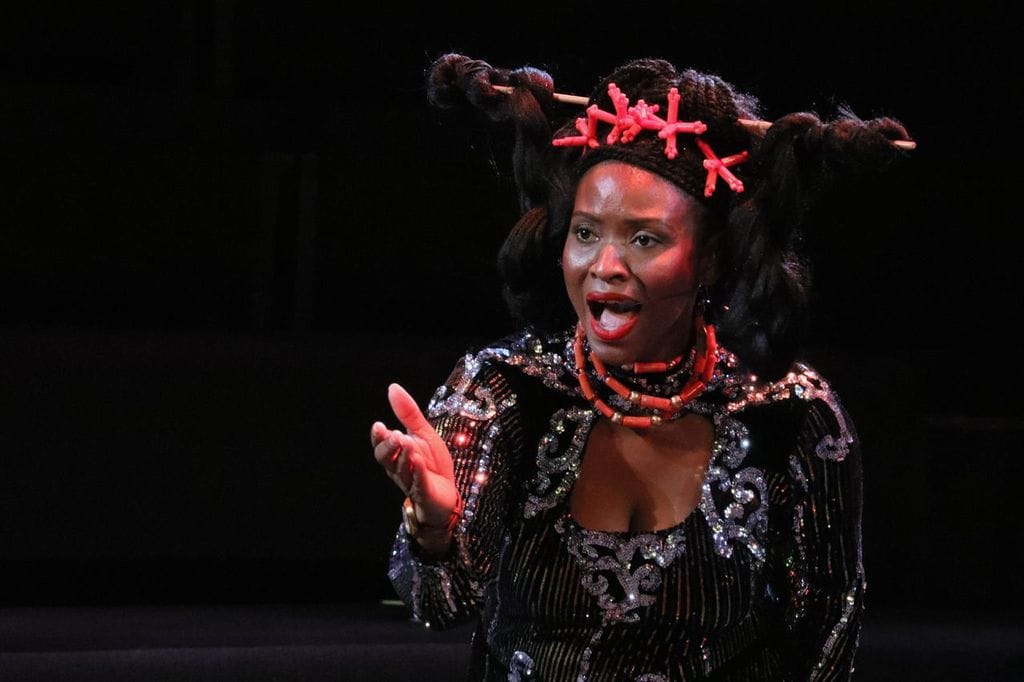
I wasn’t scared because I wasn’t aware that this had not been done before. All I knew was that this was a powerful and uplifting story that I needed to share, and I shared it, harnessing the tools at my disposal just as I had done with real and make-shift instruments growing up.
My musical career spans from being in a girl band and a punk-rocker to my work at The Venus Bushfires, exploring meditative sound journeys and African percussion with Western Classical Music. I don’t read or write music; I perceive notes and melodies as colours and shapes, and this form of synesthesia (when one sense stimulates another involuntarily) is how I largely experience the world.
I don’t feel like there’s ever been a “ready road” to walk, so I lay the ground as I go. My journey as a Nigerian-British woman in the world of classical music has often felt like a lonely one. It often feels like a rarified space with closed doors and no available seats at the table. Just like the road, I’m building my door, and I am building my own table. I no longer feel the need to be accepted or invited. I have adopted an approach of “Hello, I’m coming through”.
I don’t read or write music; I perceive notes and melodies as colours and shapes, and this form of synesthesia (when one sense stimulates another involuntarily) is how I largely experience the world.
In 2015, I met Bill Banks-Jones, the Artistic Director of Tete-a-Tete: The Opera Festival. We had a meeting, and I told him that I wanted to perform ‘Song Queen: A Pidgin Opera’ at his festival, which is the largest festival of new operas in Europe. He said, “Yes, let’s go for it.” There was one tiny little detail. Song Queen wasn’t yet written, I didn’t have a cast, and I didn’t have any funding to stage the show.
As I mentioned, I have a lot of experience making roads, tables and doors. With a few months left to showtime, I decided to apply for funding from Arts Council England. I nearly fell off my chair when the funding came through. Just in the nick of time, I was able to write, cast, rehearse and perform Song Queen within two weeks, and it’s been a monster ride ever since. I don’t build roller coasters…yet.
It's important for me to celebrate the phenomenal people who have supported and uplifted me, allowing me to have blue-sky ideas with the faith that there are people who literally make dreams come true. My husband, manager and Executive Producer of the show, Baba Epega, holds me up and helps to transform my often bonkers ideas into reality. He’s my number one fan - he’s got close competition with my parents though, my siblings, our two little girls, my friends and the amazing cast of Song Queen: A Pidgin Opera, particularly Richard Olatunde Baker (African percussion) and Francis Angol (choreographer). They’ve been part of the show since the beginning, and I am super excited to celebrate our 10th year performing the show together in 2025 with a UK-wide tour.
There are still many closed doors. Staging an opera is no small feat, and we’ve managed to do it often with a shoestring budget in comparison to other shows.
‘Song Queen: A Pidgin Opera’ celebrates Nigerian Pidgin English with Cockney, Patois, Creole, Multicultural London Slang and Ebonics with African percussion, steelpans, strings, piano, kora, contemporary dance and visual art. It is opera democratised. The story is about a warrior songstress, Kenate (the heroine), who goes on an epic journey to discover her true voice and bring harmony across intergalactic realms. Song Queen is inspired by an Africa of abundance, sharing our rich culture of storytelling with the world to spark powerful and uplifting dialogues across cultures.
Although the team and I have seen many successes with Song Queen, such as sold-out performances at Wiltons’s Music Hall and Royal Albert Hall, Elgar Room this May, and international recognition, funding, and opportunities to perform the show are a continuous challenge. There are still many closed doors. Staging an opera is no small feat, and we’ve managed to do it often with a shoestring budget in comparison to other shows.
I am a working mother and a wife, and juggling both with my creative practice can be tough emotionally and physically. But I keep pushing forward because with this show, we revolutionised the world of opera, and we continue to harness the power of music to bring seemingly disparate communities together, find commonalities and celebrate each other wildly. I have made a meaningful contribution to the UK and international arts and culture landscape.
The thing that keeps me going on days when I’m exhausted or when I question whether the sacrifices are worth it is being able to speak from experience when I tell my little girls to “dream big”.
I recognise that, and I am proud of that. But this is only the middle, and my husband and I are working on making some even more bonkers ideas a reality. The thing that keeps me going on days when I’m exhausted or when I question whether the sacrifices are worth it is being able to speak from experience when I tell my little girls to “dream big”. They see me live that mantra, and when they look at me with the same unsinkable faith I looked at my parents with when I was a child, that is everything. When I see myself through their eyes, I feel unstoppable.


Member discussion